
Everyone deserves the nutritious food they need to thrive.
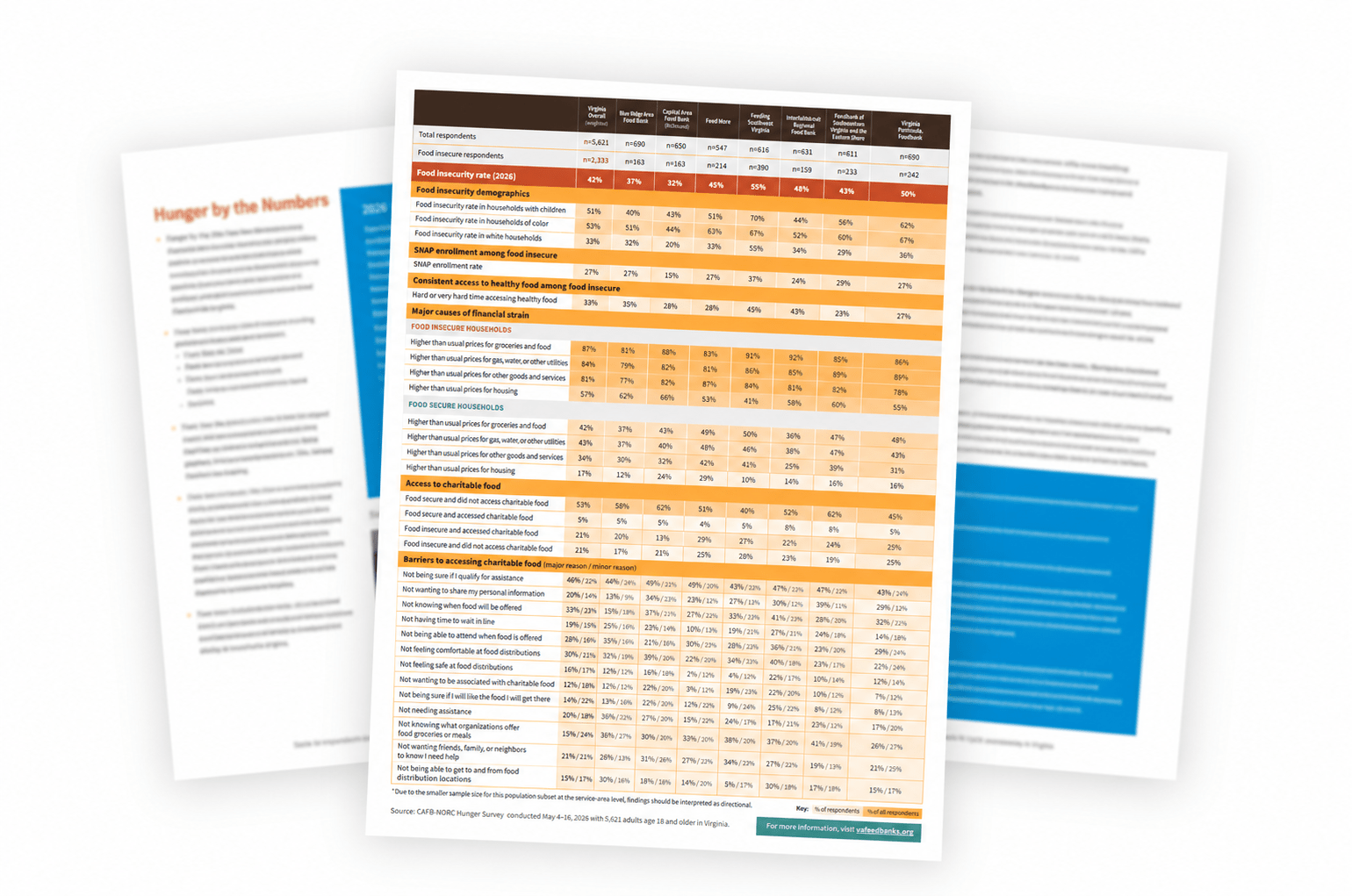
While Virginians are working hard to provide for themselves and their families, new data shows that 42% of Virginians are experiencing food insecurity. High food and household costs, including rent and health care, are putting added pressure on families, while federal cuts to SNAP and Medicaid threaten critical supports.
This first-of-its-kind study provides a comprehensive, statewide look at how Virginians experience food insecurity in their daily lives. The findings go beyond a single food insecurity rate to examine who is affected, where challenges are greatest, and the barriers that make it harder to access enough nutritious food. Together, they offer a deeper understanding of hunger in Virginia and a stronger foundation for action.

Virginia’s food insecurity rate is 42%
2 in 5 Virginians do not always have enough money or food to make ends meet

1 in 2 Children
live in households that experience food insecurity
Black and Hispanic
 householdsare more likely to experience food insecurity than white households, at 63% and 53%, respectively

Regional food insecurity rates vary
from a low of 32% in Northern Virginia to a high of 55% in Southwest Virginia.

3 in 4 food-insecure adults (76%)
have been diagnosed with one or more chronic health conditions

1 in 4 of food-insecure households is enrolled in SNAP
Others cite eligibility, stigma, lack of awareness, or administrative burden as barriers.
Source: 2026 Virginia Hunger Study, an extension of the 2026 CAFB-NORC Hunger Study
Understanding Hunger in Virginia
Food is essential for all people to maintain health and wellbeing. Yet for a large number of Virginians, putting enough food on the table can be a challenge. Food insecurity-which occurs when people have inadequate or uncertain access to adequate, safe, and nutritious food-is a major issue in the Commonwealth. To better understand the scope of this problem, a coalition of hunger relief and academic organizations recently partnered to commission the first ever Virginia Hunger Study, an extension of the CAFB-NORC Hunger Survey. The findings of the study are the result of a general population survey that is based on direct interviews with over 5,600 Virginians using the USDA’s screener for food insecurity. General population surveys provide a rigorous measure of the prevalence of key issues in the context of broader society. Surveys showed
- Black and Hispanic Virginians experienced significantly higher food insecurity rates, at 63% and 53% respectively, than their white neighbors (33%)
- 77% of adults experiencing food insecurity find it somewhat or very difficult to access healthy food.
- Adults experiencing food insecurity are more likely than food secure adults to have visited an emergency room or urgent care facility at least once in the past year (60% vs. 46%).
- SNAP recipients reported that government benefits account for half (52%) of their monthly spending on groceries, yet only 27% of households experiencing food insecurity are enrolled
Hunger is an urgent and growing threat for too many Virginians. This data underscores the need for a comprehensive public-private response to ensure every Virginian has access to the nutrition they need to thrive.
Hunger exists in every community in Virginia and is often hidden.


Learn More About the 2026 Virginia Hunger Study

Learn more in the Executive Summary
View the study’s key findings and methodology.
Explore the Data
Access additional findings and data from the study.

Read the press release
Review the September 2026 announcement and key findings.
Source: 2026 Virginia Hunger Study, an extension of the 2026 CAFB-NORC Hunger Study. The study includes interviews with over 5,600 Virginians and was commissioned through a partnership between the Federation of Virginia Food Banks, the Virginia Department of Social Services (VDSS), and No Kid Hungry Virginia. The survey was conducted by the independent nonpartisan research organization NORC at the University of Chicago with support from researchers at Virginia Tech.